The following is a letter I wrote today, as a comment on Paul Krugman's blog (not sure if it passed moderation - might have been too long), expressing my frustration with recent progressive negativity about Obama - despite agreeing with a few of their points (Geithner and Summers, in particular).
------
Dr. Krugman,
Full disclosure to begin with - I am a wholehearted progressive, with a passion for political economy, who reads your column, as well as others (Dean Baker, occasionally Dani Rodrik and Simon Johnson) regularly.
Sometimes I wonder if we progressives, just as with hard-right conservatives, are too quick to judge moves on the surface without really analyzing them. While it is true that Obama hasn't done much to radically change the narrative, to book him as JUST a centrist seems a little harsh. To use the current example, the anti-deficit plans that have come out of the White House seem aimed at trimming excesses that don't benefit current programs or goals (e.g canning the F-22). The current deficit-reduction bill seems to be one of these, spun in a "fiscal responsibility" manner. Trimming $25 billion a year over the next decade (pocket change for the US Gov) from non-critical programs (both security and major entitlement programs are exempt) can help politically - but it can also free up some marginal cash for potentially high-multiplier initiatives (e.g. high-speed rail, other energy initiatives). It certainly isn't worth railing against, as if we were talking about revisiting FDR in 1936.
Obama is not a radical game-changer, but the ONLY candidate with the potential for that in the primaries was John Edwards. So what is he then? He's a consensus-builder - but one with an eye towards long-term goals. That means an emphasis on smart industrial policy initiatives which lead the market. This can be very beneficial - in particular when dealing with green energy, and attempting to rebuild the manufacturing sector of the US (or at least the non-financial sectors, generally). He is much more in favor of incentives to innovation, rather than restrictions on behavior, save in blatantly obvious areas (e.g. pre-existing conditions).
Lastly, why did we expect him to change the narrative overnight? For that matter, would a more polarizing figure (even one with excellent grassroots mobilization) be able to get anything done in Washington - when you yourself have pointed to the Blue Dogs as a major roadblock to reform? Obama may not have pushed as hard in certain places, but he hasn't been lying down on the job, either. We've gotten major credit-card reform, phased withdrawal from Iraq on a timetable, progress towards closing Gitmo, and a 2-year stimulus package worth 3% of GDP per year. Yes, we boosted troops in Afghanistan - but Obama was very clear about doing that during the election (and their is a case to be made for it, unlike Iraq). Yes, the stimulus was too small, but did we expect the American people to suddenly become educated Keynsians overnight? "Trillion" is still a number most people have trouble comprehending - my political economy students included.
Perhaps our strategy is wrong. We need to remember that, for all that grassroots support elected Obama, progressives - by definition - are not the mainstream of society. This means we need to take the longer view at times. Rather than automatically saying "this isn't enough, it isn't why we elected you," we should actively promote Obama initiatives that broadly match up with our ideals (admittedly, you have been doing this on Health Care). Constant criticism from left-wing pundits does not help Obama's political capital - and, Wall Street reform excluded (except the potential Voelcker rule) - Obama's agenda has been, broadly speaking, a progressive one.
Wednesday, January 27, 2010
A Letter to Progressive Pundits
Labels:
Baker,
Krugman,
Media,
President Barack Obama,
progressives,
pundits
Monday, December 7, 2009
Ben Bernanke, Alan Greenspan, and the 8 Trillion dollar bubble...
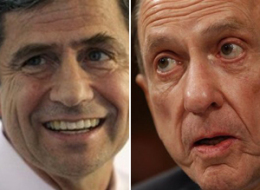
With Fed Chairman Ben Bernanke up for confirmation of his new term, it bears remembering that - although he wasn't known by the public at the time - now-Chairman Bernanke was on both the Fed Board of Governors (under Greenspan) and the US Council of Economic Advisors. As Dean Baker points out (and has repeatedly mentioned in the past), Bernanke thus bears a substantial amount of responsibility for not reigning in the rampant financial and real estate speculation that led to this whole mess in the first place.
In the midst of all the political changes associated with the Obama era, it is important to remember that the current crisis has its roots as far back as Clinton's second term. In fact, if there is one thing I object to about the Obama administration, it is that the current economic policy team has been in the halls of power for well over a decade, and has presided over the persistent deregulation of financial markets worldwide. Bernanke, Summers, Geithner, and Greenspan were largely responsible for many of the causes of the current mess. I previously posted a discussion of the domestic causes of the crisis here.
For a refresher, they were:
(1) Interest rates, since 1980s stagflation, were kept perpetually below 6%, even in boom periods. These low rates helped feed the dot-com boom, speculation in Mexico and Asia (and Russia) in the mid-1990s, and the bubbles preceding the current crisis.
(2) Deregulation of financial markets under Clinton, approved of and argued for by both Larry Summers and Alan Greenspan (and implicitly by Ben Bernanke, given the Fed's position at the time). This is eerily reminiscent of the problems surrounding nearly every major financial crisis since 1990 - including the Savings and Loan Crisis, the Mexican peso crisis, and the Asian Financial crisis.
(3) The persistent maintenance of a strong dollar vis-a-vis, particularly, the Chinese renminbi. This led to a persistent current account deficit, and related capital account surplus, fueling the speculative bubbles. Again, as Dean Baker has pointed out, these imbalances are well within our control (though his proposed solution might be a bit extreme). Incidentally, this is also why the "China will dump US debt" scare is a sham.
The imbalances discussed above are readily recognized by any graduate student in economics or political economy - in fact, some of my undergraduates with minimal economics training have noticed them as well. It is utterly inexcusable that Bernanke, Summers, et al. failed to recognize their importance, and such ignorance can only be explained by either (a) greed or (b) ideological blindness in the face of clear evidence. In the first case, these individuals are corrupt; in the second, they are wholly incompetent.
It is time we said enough is enough.
In the midst of all the political changes associated with the Obama era, it is important to remember that the current crisis has its roots as far back as Clinton's second term. In fact, if there is one thing I object to about the Obama administration, it is that the current economic policy team has been in the halls of power for well over a decade, and has presided over the persistent deregulation of financial markets worldwide. Bernanke, Summers, Geithner, and Greenspan were largely responsible for many of the causes of the current mess. I previously posted a discussion of the domestic causes of the crisis here.
For a refresher, they were:
(1) Interest rates, since 1980s stagflation, were kept perpetually below 6%, even in boom periods. These low rates helped feed the dot-com boom, speculation in Mexico and Asia (and Russia) in the mid-1990s, and the bubbles preceding the current crisis.
(2) Deregulation of financial markets under Clinton, approved of and argued for by both Larry Summers and Alan Greenspan (and implicitly by Ben Bernanke, given the Fed's position at the time). This is eerily reminiscent of the problems surrounding nearly every major financial crisis since 1990 - including the Savings and Loan Crisis, the Mexican peso crisis, and the Asian Financial crisis.
(3) The persistent maintenance of a strong dollar vis-a-vis, particularly, the Chinese renminbi. This led to a persistent current account deficit, and related capital account surplus, fueling the speculative bubbles. Again, as Dean Baker has pointed out, these imbalances are well within our control (though his proposed solution might be a bit extreme). Incidentally, this is also why the "China will dump US debt" scare is a sham.
The imbalances discussed above are readily recognized by any graduate student in economics or political economy - in fact, some of my undergraduates with minimal economics training have noticed them as well. It is utterly inexcusable that Bernanke, Summers, et al. failed to recognize their importance, and such ignorance can only be explained by either (a) greed or (b) ideological blindness in the face of clear evidence. In the first case, these individuals are corrupt; in the second, they are wholly incompetent.
It is time we said enough is enough.
Sunday, December 6, 2009
Chavez rounds up the bankers
Barack Obama could learn a lot from Hugo Chavez - at least in how to deal with the bankers. Maybe if we would follow his example, we could finally break the "Wall Street-Treasury Complex" and prevent the ridiculous lobbying by the financial industry.
BIS targets wrong people....
Apparently the BIS is worried about China's loosening of monetary policy potentially creating systemic risk.
That's all well and good, except for the fact that (a) the economy is still growing rapidly, (b) China's growth is fueled by exports, so an international investment glut is unlikely, to say the least, and most importantly (c) large lenders in China are maintaining Capital Adequacy ratios over 11 per cent.
When the banks collapsed in the Asian crisis of 1997-8, capital adequacy ratios were a mere 2-3%. In fact, standard provisioning under Basel II still runs in the 4% range. So, financial collapse, especially now that the major crisis has stabilized and international regulations are (hopefully) tightening, seems unlikely to say the least - especially in an economy where growth is NOT fueled by speculative bubbles. In short, China's looser monetary policy is far more constrained than the US and EUs policies, and backed by a much more solidly growing economy.
Dear BIS, please stop picking on the developing world, and start paying attention to the speculative financial markets fueling the current crisis - the ones in the US and EU!
That's all well and good, except for the fact that (a) the economy is still growing rapidly, (b) China's growth is fueled by exports, so an international investment glut is unlikely, to say the least, and most importantly (c) large lenders in China are maintaining Capital Adequacy ratios over 11 per cent.
When the banks collapsed in the Asian crisis of 1997-8, capital adequacy ratios were a mere 2-3%. In fact, standard provisioning under Basel II still runs in the 4% range. So, financial collapse, especially now that the major crisis has stabilized and international regulations are (hopefully) tightening, seems unlikely to say the least - especially in an economy where growth is NOT fueled by speculative bubbles. In short, China's looser monetary policy is far more constrained than the US and EUs policies, and backed by a much more solidly growing economy.
Dear BIS, please stop picking on the developing world, and start paying attention to the speculative financial markets fueling the current crisis - the ones in the US and EU!
Friday, December 4, 2009
Proposed Financial Transactions Tax is...
The single best idea for preventing another financial crisis and ensuring job growth in the middle class.
See the proposal here: http://www.defazio.house.gov/index.php?option=content&task=view&id=532
Justifications can be found here (the PDF file is especially useful; other links indicate broad-based support).
See the proposal here: http://www.defazio.house.gov/index.php?option=content&task=view&id=532
Justifications can be found here (the PDF file is especially useful; other links indicate broad-based support).
Subscribe to:
Posts (Atom)